
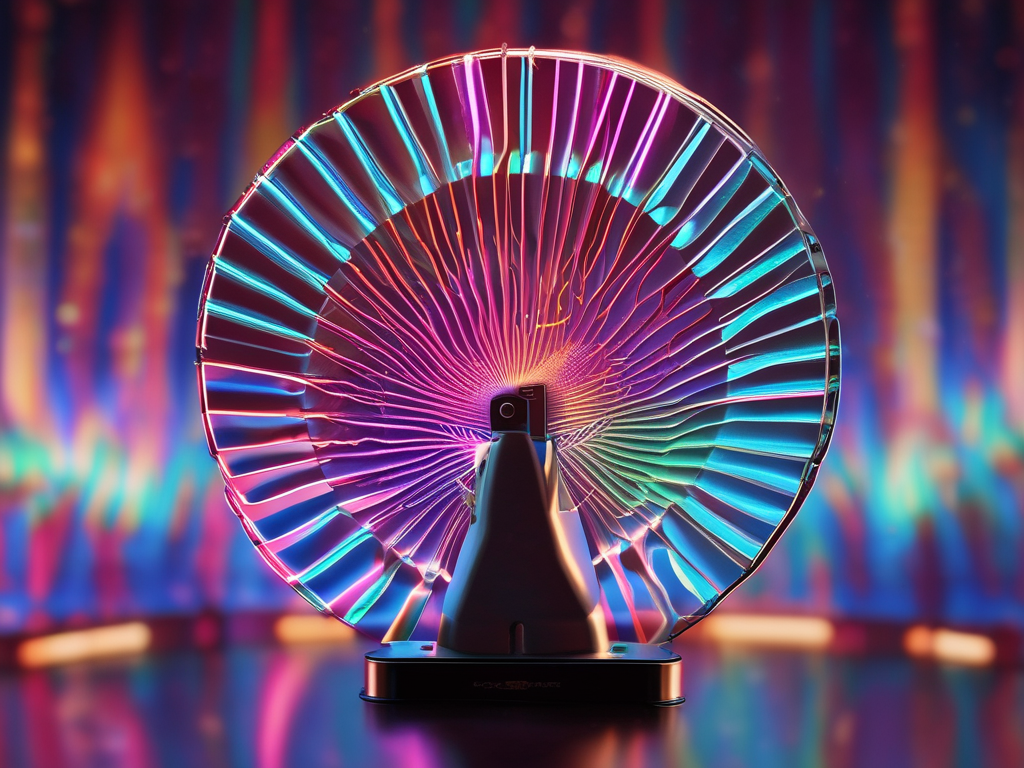
3D holographic displays make it possible to create a visual brand experience that harnesses power of neuromarketing. Neuromarketing is the measurement of physiological and neural signals to gain insight into customers’ inclinations, preferences, and facilitates decision-making on the customer’s part. It also boosts creative advertising, product development, pricing, and other marketing areas.
Free-floating holograms are three-dimensional images that appear to float in mid-air without the need for physical screens or surfaces. These holograms are created using advanced light manipulation techniques, such as laser projection, diffraction, and interference patterns.
Holographic fan produces an illusion of 3D objects floating in the air, by having strips of RGB (red, blue and green) light emitting diodes, attached to the blades of the fan and a control-unit lighting up the pixels as the fan turns around, to produce the full picture. The fast-spinning fan becomes nearly invisible to the naked eye and the projected object thus gets a transparent background.
When looking at a holographic display, the brain is instantly tricked by the illusion of having a palpable object in real surroundings mixed with the three-dimensional digital superimposition. The visual experience immediately conjures up emotions and triggers the senses to fire up the activity in the cerebral cortex, that makes the processing of thought, retainership and further communication about the same better.
The seemingly free-floating holograms have a natural ability to make people stop and pay attention in any crowded setting. These can be of great use in spaces like a retail store, at an expo, exhibition arenas or in public spaces like for advertisement and marketing in shopping malls and airports.

Pioneer Corporation’s Technological Innovations
Pioneer Corporation has been at the forefront of developing cutting-edge display technologies. Our approach to free-floating holograms likely involves several key innovations:
- Laser Projection Systems: Using high-precision lasers to project holographic images that can be viewed from multiple angles without distortion.
- Optical Diffraction: Employing diffraction gratings to control the direction of light and create the illusion of depth and volume.
- Real-Time Rendering: Integrating powerful graphics processors to render complex holographic images in real-time, ensuring smooth and responsive interactions.
Applications of Free-Floating Holograms
Free-floating holograms have a wide range of potential applications, including:
- Entertainment: Creating immersive experiences in movies, concerts, and video games by projecting characters and scenes that appear to interact with the audience.
- Advertising: Catching consumer attention with dynamic, floating advertisements in public spaces.
- Education: Enhancing learning experiences with interactive, 3D visualizations of complex subjects like anatomy, astronomy, and engineering.
- Medical Imaging: Providing doctors and surgeons with detailed, three-dimensional views of patient anatomy, aiding in diagnosis and surgical planning.
- Automotive Displays: Offering heads-up displays (HUDs) in vehicles that project important information and navigation cues directly into the driver’s line of sight.
Challenges Of Using Free-Floating Holograms
Developing and deploying free-floating hologram technology comes with several challenges:
- Image Stability and Clarity: Ensuring that holographic images remain stable and clear, even in varying lighting conditions. Pioneer likely uses advanced algorithms and optical components to maintain image quality.
- Interaction Capabilities: Enabling users to interact with holograms requires sophisticated motion tracking and gesture recognition systems. This may involve integrating sensors and cameras to capture user movements accurately.
- Power Consumption: Managing the energy requirements of laser projectors and processors to make the technology viable for everyday use. Pioneer might focus on optimizing power efficiency and heat dissipation.
Future Prospects of Free-Floating Holograms
The future of free-floating holograms is promising, with ongoing research and development aimed at making the technology more accessible and versatile. Pioneer Corporation’s continuous innovation in this space is likely to lead to more practical and widespread applications, further enhancing visual engagement across various domains.
In summary, Pioneer Corporation’s advancements in free-floating hologram technology represent a significant leap forward in visual display systems. By addressing technical challenges and exploring diverse applications, they are poised to transform how we interact with digital content in the physical world.
#holographicimage #holograms #holographicfan #holographicprojection


Hello friends appreciate the time you took out to read the post , please leave a comment